

Insects are capable of amazing autonomous feats well beyond current computers, such as navigating across hundreds of kilometres. Here, we want to realize artificial neural networks inspired by neurobiology with our combined skills in nanotechnology.
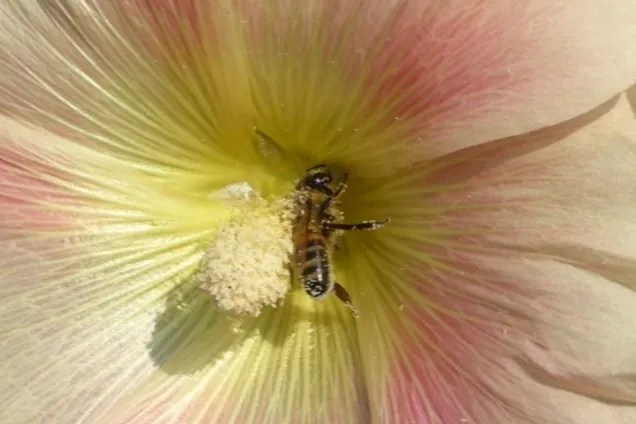
How bee brains are shaping next-generation computer chips
Can a bee’s brain teach us to build better computers? Bees navigate with remarkable precision using less than one hundredth of a watt of energy, while today’s navigation chips often use over 7 watts and weigh about 80 times as much as a bee. In an interview with Horizon, Anders Mikkelsen, coordinator of the European Innovation Council-funded project InsectNeuroNano, tells us about how nature’s navigators can be turned into insect-sized robots to help create a cleaner future.
Bees navigate their surroundings with astonishing precision. Their brains are now inspiring the design of tiny, low-power chips that could one day guide miniature robots and sensors.
When a bee leaves the nest, it already has its own version of a GPS in its head. By analysing patterns in the sky and its flying speed, a bee can keep track of its location and safely return home. Researchers are now taking their cue from this in the hope of transforming how computers find their way around.
“A bee finds its way back without a smartphone or satellite navigation,” said Anders Mikkelsen, professor at Lund University in Sweden. “They do this by looking at the polarisation of the sky, and their speed. Based on that, they don’t get lost.”
The interview with Anders Mikkelsen is published in Horizon – the EU Research & Innovation Magazine
About InsectNeuroNano
The goal of the project is to develop nanophotonic on-chip devices for integrated sensing and neural computation, inspired by the insect brain. This will uniquely combine four lines of research:
- Progress in understanding insect neurobiology that provides proven circuit designs to solve significant problems such as autonomous navigation;
- Advanced III-V semiconductor nanowire technology that exploits light to obtain a large number of interconnects with extremely low power consumption;
- Optically efficient stable molecular dyes that can be used for novel memory components;
- Circuit technology developed for quantum computing.
As proof of concept, we target the complete pathway from polarised light sensing in the insect eye to the internal compass and memory circuits by which this information is integrated in a continuous accurate estimate of location.
The project is funded by the EC in the Horizon Europe programme (GA 101046790). The project will start on 1st of April 2022 and run for four years.
The project is a collaboration of research groups at Lund University, the University of Copenhagen, the University of Edinburgh and University of Groningen.

Coordinator: Anders Mikkelsen
Email: anders [dot] mikkelsen [at] sljus [dot] lu [dot] se

Funding (Horizon Europe Programme, Project 101046790 - InsectNeuroNano) is gratefully acknowledged.


